A survey of space shuttle Atlantis' outer body has revealed that four tiles on the right side have "some dings" in them, the flight director said Tuesday.
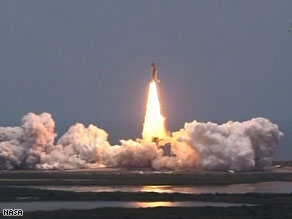
Space shuttle Atlantis launched from Florida Monday on its way to the Hubble telescope.

"As we were going through the surveys we did see probably about 21 inches in all ... four tiles with some dings in them," Tony Ceccacci told reporters.
"To me, I'm not the tile expert, but they looked very minor."
He said tile experts will examine the dings, which are on the wing.
Ceccacci said an "event" occurred around 103 seconds into Monday's launch.
He said NASA is looking into what may have caused the nicks. Debris that fell off the external fuel tank during liftoff has been the culprit on previous flights.
Atlantis launched Monday afternoon for NASA's fifth and final repair visit to the Hubble Space Telescope, with which it is scheduled to rendezvous on Wednesday.
It has been seven years since NASA's last mission to service the Hubble, which was designed to go only about three years between fixes.
That disaster was blamed on a hole punched in the front of the wing by debris during liftoff.
But public pressure and steps taken to increase shuttle safety led the U.S. space agency to reconsider.
Space shuttle Endeavour is on standby at the Kennedy Space Center in Florida in the unlikely event that NASA will need to rescue the Atlantis crew members during their 11-day mission. Read more!


 Ares V is the rocket that will deliver NASA's next manned lunar lander to the moon as well as all the cargo needed for a lunar base. Its roomy shroud could hold about eight school buses, and the rocket will pack enough power to boost almost 180,000 kg (396,000 lbs -- about 16 or 17 school buses) into low Earth orbit. Ares V can haul six times more mass and three times the volume the space shuttle can.


 This is the first time that an Indian built spacecraft has broken away from the Earth’s gravitational field and reached the moon. This historic event occurred following the firing of Chandrayaan-1 spacecraft’s liquid engine at 16:51 IST for a duration of 817 seconds. The highly complex ‘lunar orbit insertion manoeuvre’ was performed from Chandrayaan-1 Spacecraft Control Centre of ISRO Telemetry, Tracking and Command Network at Bangalore.


